10acity Lite: Contents
10acity Lite is the lightest version of the 10acity system designed for narrators who wish to focus more on a story and less on the mechanics of a game. The ruleset here is scaled back to provide quicker and simpler conflict resolution so that the mechanics of the system gently supports your story without “ruling” it. 10acity Lite is no less of a complete system than 10acity Storyteller or Tactics, it is simply a rule set designed to be more quick and easy streamlined gameplay.
First rule of 10acity Lite is that you don’t talk about 10acity Lite… at least not in the idea of having to reference rules as written. The idea is to have less looking up anything and quickly moving forward with the story. You are still going to have character abilities, equipment, and guidelines for challenge resolution, but you’ll be focusing more on the narrative rather than looking up rules. 10acity Lite is really about cutting through the red tape and getting right into gaming. As such, we strip down the tactical and tracking aspects to be quick and easy. 10acity Lite works great for theater of the mind and play by post gaming.
To play the 10acity Lite rpg you will need to choose someone to be the Narrator, this is the person that guides the story; what what other systems would call the Game Master (GM), however, since 10acity is a narrative driven system, we refer to them as the Narrator. You will need up to five (5) ten-sided dice (d10). You will build a character using the rules in the Character Creation section which will then establish your character's capabilities. When the game has a challenge that must be overcome then the narrator will assign a difficulty rating between 1-10 for that challenge and then a certain amount of d10 dice will be rolled by player to try and overcome that challenge rating.
The Narrator
The narrator guides the overarching story using the player characters as the main protagonists. That means that the Narrator describes environments and non-player characters (NPCs) that the player characters interact with. As the player characters interact with this world, their actions will affect the story progresses. The narrator, either using their own story or a module, will be the person who paints the picture and describes the results of actions taken by the player characters. During the progress of this story, the player characters will eventually be faced with challenges that they will need to overcome. This is where the abilities of the characters on their character sheet and rolling the dice will come into play.
Character Statistics
The character sheet is where your character is described and where their abilities, equipment, and health is listed. Characters are created on a tag system where each tag is a skill or ability that the character representing the character's expertise. This is described in greater detail in the character creation section.
Each tag represents a character's expertise in the selected tag. For example, the tag called Profession: Engineer would increase how good the character is at fixing and creating mechanical objects. While the tag called Combat: Marksman would increase how good the character is at ranged combat actions..
Every adventure, mission, chapter, etc. is called an expedition. Performing expeditions gives rewards in the form of character points for character growth and wealth points for special equipment. A Narrator sets these rewards for each expedition. If multiple expeditions are available (mission boards, bounty hunts, etc.) each one can have different rewards. A short basic straight forward expedition would award 1 character point and 1 wealth point. While harder or more complex expeditions could offer multiple character and wealth points, but would be much more risky and difficult to accomplish.
Character points can be spent to enhance your character. Wealth points can be used to buy special equipment.
Character Enhancements:
- 1 = gain 1 wealth point
- 1 = gain 1 luck point
- 3 = gain 1 hitpoint
- 10 = gain 1 tag
Examples of Equipment:
- Healing Stim (1 wealth point): 5 uses, restores 10 hitpoints up to character maximum.
- Piercing Shots (1 wealth point): 5 uses, can be used once per attack to deal 1 extra damage per ranged attack.
- Good Luck Token/Lucky Rabbit's Foot (1 wealth point): Spend to immediately gain 1 luck point. Usable only once then needs to be purchased again to recharge the luck point.
- Night Vision (2 wealth points): Allows sight in dark conditions.
- Retractable Grapple Hook (2 wealth points): Use to reach new heights! Bonus dice on checks that involve climbing, swinging, grappling, etc. Can be used 3 times before needing to be recharged for 3 hours.
- Armor (3 wealth points): Reduces damage taken from any attack by 1.
- ...more equipment available in the equipment section...
When a character wishes to perform an action, first the narrator assesses if they can even do it. For example, you can shoot at a target as long as you have a ranged weapon, but without some sort of ranged weapon you can't shoot anything. A large character might have a chance to lift a car off of someone's legs, but a character the size of a mouse wouldn't. A mouse sized character could probably squeeze through a small hole while a large character would be stuck. If there is any question on the character's ability to try the action, it should be a discussion between the players and the narrator with the narrator having final judgement.
Once an action is determined possible, the character describes how they're going to do it and the narrator assigns a difficulty for that character on a scale of 1 to 10 where 1 is very easy and 10 is practically impossible. The difficulty can be different from character to character, for example a very large character might have a challenge of 3 to hop across a gap, while a very small character might have a challenge of 7 to leap the same gap as it is a much further jump for them.
After the character explains how they are going to accomplish the task, they will explain if any tag or special equipment listed on their character sheet would help them with the task. If so, this will give additional 10 sided dice (d10) that the character will get to roll to attempt the action. They roll all their dice and take the highest rolled result. So the more dice you have, the more likely you will be to roll a higher number.
Determining how many d10s a character can roll for their action:
- If they have the ability to try the action they get to roll a 1d10.
- If they have a tag that would help them perform the action, they get another d10.
- If they have special equipment (specialized hacker computer) or a tactical advantage (I have the high ground!) that can help then the narator might award another d10.
Rolling One Die
In the case listed above where the character has the ability to attempt something, but no particular skill for that action, they would only get one die. For example, if someone wanted to land an aircraft after the pilot was knocked out but has no piloting ability. Technically, they can put their hands on the controls, so they have the ability to try, but they have no skill in it so they would only roll a single die and the narrator would probably make it a difficult check of somewhere around 7 or 8. If they beat the challenge number then they somehow figured it out and managed to get the aircraft on the ground without causing too much damage. If they miss the target, then they cause damage to the aircraft and people inside equal to how much they missed the roll by. On a tie, you split the difference, you didn't mess it up, but it wasn't a complete success either, something went a little wrong and maybe the aircraft now needs new landing gear.
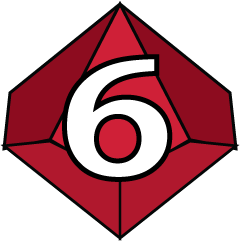
Here, the character rolled their 1 die which resulted in a 6, so their outcome for this action would be 6 since that is the highest valued result of the die that they rolled.
Rolling Two Dice
In the case listed above where the character had a tag that gave them expertise in the action they are attempting. They would roll 1d10 for being able to attempt the action and another d10 because they're good at it (2d10). So they would roll 2d10 and take the highest result. Let's take the same example from above, a pilot is unconsciouss and the player wants to attempt to land the aircraft. First off, someone with piloting experience probably wouldn't even need to roll, they would just be able to land the aircraft. But, let's say there was something wrong with the aircraft... one of the engines is out. Now it becomes more challenging. The Narrator looks at the situation and says even an experienced pilot would have some issues here and puts the challenge rating at 4, meaning the pilot has to roll a 5 or higher to succeed. Since the character has the pilot tag, they get and additional d10 to attempt to overcome that challenge and so rolls 2d10 dice and takes the highest value.
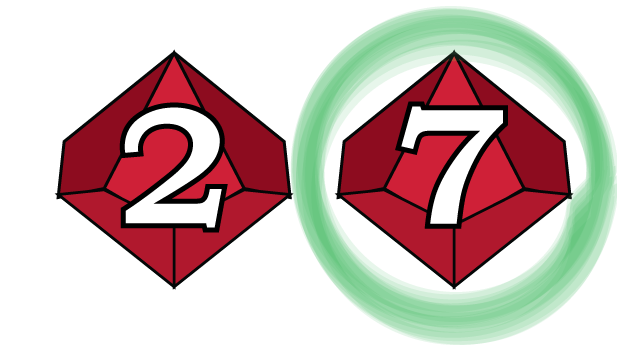
Here, the character rolled their 2 dice which resulted in a 2 and a 7, so their outcome for this action would be 7 since that is the highest value rolled from all dice.
Rolling Three Dice and So On...
As characters grow in ability, there are opportunities for tags to overlap. Let's say that the pilot in the previous example also has the Profession: Scientist tag. Now they might be able to convince the narrator that their in-depth knowledge of physics will help them determine the best possible angle in which to land the aircraft. If the narrator agrees, they would get a third d10 die for having another tag that can help their piloting tag.
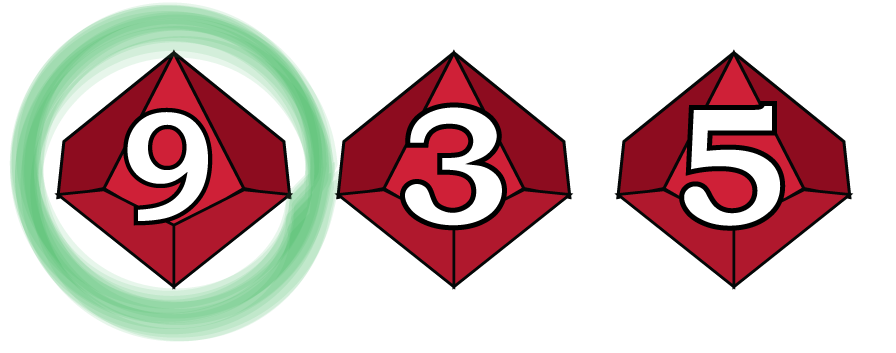
Here, the character rolled their 3 dice which resulted in a 9, a 3, and a 5, so their outcome for this action would be 9 since that is the highest value rolled from all dice. And so on and so forth for however many dice your character rolls for their action.
Rolling Doubles
When you are able to roll more than one d10, you open up the ability to rolling doubles (2 dice rolling the same number). When you roll doubles of any number other than 1 on your d10's, it means that luck was on your side during that action and you gain a luck point that you can use at any time for the remainder of the scene. You can gain and spend an unlimited amount of luck points during any scene, but they all expire at the end of the scene and resets to 0. The opposite is true if you roll double 1's, it means luck was against you and the action not only fails, it fails hard. The narrator then gets to explain exactly how badly that action went wrong.
Luck Points
Luck points are able to spin things just a little more in favor for the character when taking any action. At any point after a character rolls an action, they can spend luck points to do any of the following (There is no limit to how many luck points a player may spend during any action):
1. Add +1 per luck point spent to the resulting d10 value of any action roll.2. Completely reroll the entire action as if it were never rolled.
3. Temporarily activate one wounded (crossed off) tag for that action. The tag remains wounded and crossed off, but is temporarily able to be used for that one action.
4. Temporarily activate one damaged (crossed off) vehicle component for that action. The vehicle component remains damaged and crossed off, but is temporarily able to be used for that one action.
Taking Actions
Many challenges will only require a single roll to accomplish like jumping across a gap, but sometimes something might require multiple rolls. For example, hacking a terminal to open a door might require a number of success points to accomplish. If a terminal required 4 points to hack and the character only beats the narrator's challenge roll by 2, then they would have to try again to see if they can get another 2 for the total of 4. If not, they'd have to try again after that until the total result of all their attempts is or greater. This can make certain challenges more difficult as it takes multiple actions to accomplish the task and if the team is in the middle of combat, is on a time limit, or if it would only take one failure to set off an alarm or something like that, then it can make an otherwise simple situation more dramatic.
Combat actions work pretty much the same way as standard actions except that the result can now deal damage, create a condition, or generate a luck point. Combat actions aren't just single attacks, they are exchanges between the characters and the opponents. When a character enters combat with an opponent, it is an exchange of maneuvers as the opponent also tries to deal damage to the character at the same time as long as they have the ability to do so.
Attack Actions
When attacking, you decide whether or not you are trying to injure or eliminate the opponent by dealing stress damage, trying to apply a condition, or trying to give someone on your team an advantage (aka giving them a luck point).
Dealing Stress Damage
When taking combat actions, the character is always the focus of the narrative and the narrator never really needs to roll (unless they want to, see alternative narrator rolling rules). When the character enters a situation in which they choose to fight, the narrator assigns a combat value to the opposition and that's the challenge rating that the character will need to beat to deal damage to that opponent. If the character rolls over the challenge rating, then the number that they rolled over the target is how much damage the character does to the opponent. However, if the character rolls below the challenge rating and the opponent is able to attack the character, then the character takes that amount of damage instead. In a tie, their exchange ended in a stalemate and neither takes any damage.
Sometimes the opponent will be unable to make the combat an exchange. For example, a sniper targeting an unarmed opponent walking across a bridge. If the sniper rolls below the challenge rating assigned by the narrator, the sniper would not take any damage from their opponent because their opponent doesn't know they were being attacked and even if they did they are unarmed and too far away to try to punch the sniper. So instead of attacking back, the target would perform a different action such as jumping behind cover where the sniper would no longer have a clear shot to the target.
Sometimes opponents will be better at certain types of combat than others. For example, if the character is in a firefight with a sharpshooter, the challenge for the character might be 6 because the sharp shooter is pretty good at diving for cover and shooting at people. However, if that same character closes into melee range and tries to stab the sharp shooter with a knife, the challenge could drop to 4 because the sharp shooter is not as good in melee as they are with ranged weapons.
Equipment Note: Sometimes equipment can give bonuses to damage, in this case the character has to deal at least 1 point of damage to the opponent through combat exchange action in order to add any damage from their equipment.
Narrator Note: Most general mooks and minions only have 1 hitpoint and are easily eliminated on any successful attack, but much more dangerous in large numbers. More specialized, elite, or boss opponents can have many more stress hitpoints and armor making them much more difficult to eliminate.
Narrator Rolling Option: If a Narrator wants to make combat a little more random or dramatic, they can assign a number of d10s to the opponents instead of a challenge rating and roll the dice to establish the result for the player to beat with their action rolls. 1d10 for an easy challenge, 2d10 for moderate, 3d10 for difficult, 4d10 for extremely difficult. This creates a higher stakes challenge as the numbers are now randomized for both character and opponent and can make combat more engaging especially for boss battles where the bosses may gain tactical advantages for additional d10s or have other equipment and abilities that can affect the fight.
Create an Advantage
Creating an advantage can generate a luck point for you or one of your allies. By doing something tactical or creative, you can roll an action against a challenge set by the narrator, and upon success you give a player 1 luck point. If the action that the character is attempting still puts them in danger, then they can still take damage or be affected by opponents if they fail while trying to create and advantage.
Apply a Condition
A conditions can be applied to a character, object or location. For example, one condition could be setting something on fire. If it's a person, then the narrator could make them take all their remaining actions in a panic to put themselves out, cause them damage, or something else narratively appropriate. If an object was set on fire, then whoever is holding it would probably drop it and it would probably burn to ashes in a few rounds. If it is a location, then anyone entering the location would catch on fire.
Any action against an opponent that doesn't deal damage or create an advantage (setting them on fire, trying to freeze them in place, grappling them in a head or arm lock, disarming, capturing them in handcuffs, etc.) is most likely trying to produce some sort of condition. Conditions last until something removes the condition and the narrator describes the effect of the condiiton based on how they believe the action would affect the target and the story. If the action that the character is attempting still puts them in danger, then they can still take damage or be affected by opponents if they fail when trying to create a condition.
Stress Hitpoints and Wounds
All characters start with 10 stress hitpoints (this can be increased through character advancement). This represents the little scratches, bumps, bruises, and strains that a character receives during action and resets after taking a short rest. If a character takes damage, they lose stress hitpoints. Once they run out of stress hitpoints they can either fall unconscious or choose to take a wound point in order to reset their hitpoints back to full. Stress hitpoints can be healed during scenes, but wounds are severe injuries and take multiple days, weeks, or even months to recover.
At the end of a scene, stress hitpoints automatically reset with a brief rest. Wounds do not and will persist until the character has the time to rest and be treated.
If a character takes a point of wound, they cross off one of their tags. The wound is now interfering with their ability to use that tag and they cannot receive any bonus d10's from that tag when taking actions. The narrative description being that they were wounded in such a way that prevents their ability to utilize the ability (can't fight as well with my injured arm, can't run as fast with my injured leg, can't concentrate through my throbbing head to use my magic, I'm having trouble remembering my engineering skills after taking that hit to the head, etc.). The tag will become available again later once they recover from their wounds. If a character does not have any more tags to cross off, then they cannot take any more wounds and must fall unconscious when they run out of hitpoints.
Healing:
Any character can try to restore stress hitpoints to a character as long as they can touch the character. Roll a check and take the highest roll of your d10s, the character recovers half that amount rounded down. Certain tags and equipment can heal more, faster, and even at a distance.
Death:
Dying isn't easy in 10acity Lite, but it can happen. At any point when a character is unconscious, an opponent can attempt a coup de grâce to kill the fallen character. This requires the opponent to spend two consecutive uninterrupted actions on finishing off the character. If they complete both actions without being interrupted, the character is eliminated.
Restoring Wounds:
There are three options for restoring wounds that the narrator can choose for their game:
- No Tracking: Automatically wipe them away if medical care is sufficiently advanced or enough time passes between expeditions.
- Time Tracking: 1 week of recovery removes 1 point of wound. 2 weeks if not being treated by someone with a healing tag.
- Time and Skill Tracking: Every day is a roll to see how much recovery a character gains and each point of wound makes the recovery time longer. Take the amount of wounds and multiply it by 10, that's how much recovery it requires to remove one point of wound. After that wound is removed, multiply the remaining wounds by 10 and that is how much recovery it requires to remove the next point of wound, so on and so forth until there are no wounds left. Every day in someone's care allows the one performing the care to roll a check for medical attention and the highest rolled value is how much recovery the character receives for that day.
Each tag represents a character's expertise in the selected tag. For example, the tag called Profession: Engineer would increase how good the character is at fixing and creating mechanical objects. While the tag called Combat: Marksman would increase how good the character is at ranged combat actions. Often tags will give small benefits as well as the d10 bonus. For example: Fire Magic gives the character the ability to create fire as well as an extra d10 anytime they are doing anything with fire. List of tags coming soon!
Suggestion: When trying to determine which Tags to select for your character, sometimes it helps to visit the Tags page and just enter key words for your character concept into the search bar to see what is available and give you ideas. For example: for a healer you could look up: "heal", "doctor", "med", etc. For a solder you might look up "attack", "melee", "weapon", etc. For a psychic you could do: "psychic", "tele", etc. The search will pull up any ability that has the word in the title of the ability or in the description.
Note: This list of Tags is not comprehensive and new Tags are added all the time. If you don't see one that encompasses an ability or skill that your character would have, tell your narrator and together you can create a new one.
Equipment
Basic equipment isn't tracked. Having items that are fairly easy to get your hands on like a sword, knife, pistol, rifle, a lighter, rope, water bottle, binoculars, etc. (basically anything that you could buy off of the shelf in a store) is easy enough for the character to have without having to specifically track them (unless they are in a situation where equipment could be taken away such as captured or arrested). This equipment gives no bonuses, it just allows the character to attempt an action. For example, if you want to try shooting someone, you can't even attempt it without at least a basic gun. You can't even try hacking a computer without at least a basic data pad or computer. There are special items out there that do more than basic items can do, for example a hacker pad gives additional bonuses that a standard data pad or computer would not, but those items cost resources. More about that later. Most times characters just have basic equipment, but if they want something way out of left field, like a pair of roller skates, then it's probably best to mention that before the expedition. Otherwise, if there is ever a question on whether or not someone could have thought to bring something out of the ordinary with them, they can roll a check against the narrator's challenge rating to see if they would have thought to bring it (or you could take the "resourceful" tag).
Special Equipment
Special equipment is anything that would be unique, expensive, or difficult to get your hands on such as: most vehicles, heavy weapons, laser swords, grenades, specialized ammo, retractable grappling hooks, jet packs, etc. Special equipment can be found in game or purchased with wealth points that are awarded at the end of chapters. Special Equipment gives the ability to perform actions that you otherwise would not be able to (jet pack to fly, night vision goggles to see in the dark, grenades to attack a group of opponents in a single action, etc.). Many of these items have limited uses. A grenade can only ever be used once and the item is discarded after it is used. Special ammo clips might have 6 shots that can deal extra damage before it's empty, a retractable grapple hook might be able to be used 5 times before needing to be recharged, a jet pack might be able to be used for 10 turns before needing refueling, etc.
Ranges
Ranges in 10acity Lite isn't exact, it's an approximation using the following basic guidelines:
| Personal: | touch with hands or standard sized weapons. |
| Reach: | touch with very long weapons like spears and whips (about 10 feet/3 meters or so). |
| Short: | Can travel across a large sized room (about 30 feet/10 meters). |
| Medium: | Can travel across a gymnasium (about 100 feet/30meters). |
| Long: | Can travel across a football field (about 300 feet/100 meters). |
| Extra Long: | Can travel up to about a mile/1.6 kilometers. |
| Vehicle Range: | Many miles/kilometers. |
Approximate detail you can see on a person at different ranges unassisted
| 100 meters/yards: | You can see facial features. |
| 200 meters/yards: | You can see the colour of the face and gear but can't see facial features. |
| 300 meters/yards: | You can see a body outline and usually face colour, but little more detail than that, no hands or the colour of pieces of gear. |
| 400 meters/yards: | The body outline is about all you can see, the head starts to blend in to the shoulders. |
| 500 meters/yards: | You begin to lose details on the body shape, individual limbs can be hard to determine. |
| 600 meters/yards: | No head distinguishable, person is a triangle shaped dot. |
Sizes and Area
Sizes and areas in 10acity Lite isn't exact, it's an approximation using the following basic guidelines:
| Hand Sized: | Can easily be held in your hand. |
| Arm Sized: | Can easily be held within both arms. |
| Person Sized: | Approximately the size of the character. |
| Tent Sized: | Approximately 10 feet/3 meters cubed. |
| Room Sized: | Approximately 20 feet/6 meters cubed. |
| House Sized: | Approximately 50 feet/15 meters cubed. |
| Gymnasium Sized: | Approximately 100 feet/30 meters cubed. |
| Football Field Sized: | Approximately 300 feet/100 meters cubed. |
| Skyscraper Sized: | Approximately 1,000 feet/300 meters cubed. |
| Mile Sized: | Approximately 1 mile/1.6 kilometers cubed. |
Speeds
Standard speeds:
| 1: | A good run (About 10-20 miles per hour). |
| 2: | A fast bicycle / average scooter (About 25-50 miles per hour). |
| 3: | An average car (About 100 miles per hour). |
| 4: | A fast car / slow aircraft (About 150-250 miles per hour). |
| 5: | A jet (About 300-600 miles per hour). |
| 6: | A fighter jet (About mach 2 or 3 / 1,500-2,500 miles per hour). |
| 7: | A scramjet aircraft (About mach 10 / 10,000 miles per hour). |
| 8: | A spacecraft that can leave atmosphere (About 25,000 miles per hour). |
| 9: | A fast spacecraft (About 50,000 miles per hour). |
| 10: | A comet (About 200,000 miles per hour). |
Faster than light speeds:
| 1: | 1x the speed of light. |
| 2: | 5x the speed of light. |
| 3: | 15x the speed of light. |
| 4: | 50x the speed of light. |
| 5: | 250x the speed of light. |
| 6: | 1,000x the speed of light. |
| 7: | 5,000x the speed of light. |
| 8: | 15,000x the speed of light. |
| 9: | 50,000x the speed of light. |
| 10: | 250,000x the speed of light. |
Vehicles require piloting checks to make them move. If you have the pilot tag, then you can do basic maneuvers in normal circumstances without rolling any dice. If you don't have the piloting skill, even simple maneuvers can fail and the narrator might require a roll if something bad could happen.
Each vehicle has a predefined amount of stress hitpoints based on size and a set of vehicle components (tags) that they can contain. The larger the vehicle the more stress hitpoints and components they can have. Additional components and component slots can be purchased for vehicles with wealth points as the game goes on if you wish to continue to improve your vehicle throughout the story. Vehicles take stress hitpoint damage just like characters. When they are out of stress, a vehicle cannot fall unconscious and so automatically takes "wound" damage and loses component tags in the same way a character loses tags as they take wounds. After this wound, the stress hitpoints resets and they can take that amount of damage again before they lose another component. This represents the systems and components of the vehicle becoming damaged and going offline as the vehicle takes hits. Some components, such as armor or shields, are specifically there just to take the wound damage instead of a more useful component. Other components have redundancies, such as engine 1 and engine 2. If engine 1 takes the wound and goes offline, then engine 2 will still be there, their speed would be reduced by half, but they would still be able to move.
Damaged systems and components can be temporarily reactivated for a single action by spending a luck point, or patched by engineers who can get to the damaged components to reactivate for the scene by rolling a check above the Narrator's assigned challenge rating based on the difficulty of the repair, but permanent repairs will be required after that. Permanent repairs take time and are performed by spending 1 wealth and the engineer rolling against the Narrator's assigned challenge rating based on the difficulty of the repair. Every point above the challenge rating that the engineer rolls is 1 component that can be repaired with that wealth point in that amount of time.
Small Vehicle (around person sized)
5 hp
Limit 4 components
Examples: Motorcycle, jet ski, power armor, ultralight, etc.
Medium Vehicle (around car to small house sized)
10 hp
Limit 8 components
Examples: car, truck, tank, speed boat, small aircraft, small spacecraft, small mech, etc.
Large Vehicle (around gymnasium to apartment building sized)
15 hp
Limit 12 components
Examples: passenger jet, construction vehicles, yacht, large starship, large mech, etc.
Giant vehicle (around the size of a stadium)
20 hp
Limit 20 components
Examples: cruise ships, capital starships, space stations, etc.
SAMPLES:
MOTORCYCLE
Properties:
Size: 8 Feet long
HP: 5
Components:
- Maneuverability: +1d10 to piloting check
- Engine: Speed 4
- Wheels: Street / Light Offroad
POWERARMOR
Properties:
Size: 8 Feet Tall
HP: 5
+1 to Unarmed strike damage
Components:
- Strength Enhancement: +1d10 to strength checks
- Armor Plating
TANK
Properties:
Size: 20 Feet long x 10 Feet Wide
HP: 10
Components:
- Sensors: 1 Mile Range
- Engine: Speed 2
- Cannon: +3 Damage
- Treads: Heavy Offroad
- Armor Plating 1
- Armor Plating 2
STARSHIP
Properties:
Size: 100 Feet long x 50 Feet Wide x 30 feet tall
HP: 15
Components:
- Sensors: 100 Mile Range
- Engine 1: Speed 4
- Engine 2: Speed 4 (total speed: 8)
- Turret: +2 Damage
- Shields
- Armor
- Life Support
- Communications Array
- FTL Drive: FTL Speed 3
- Cargo Hold: 10 tons
- Crew Cabins: 6